

AI is changing how sales teams understand buyer behavior. By analyzing subtle buying signals like website activity, search patterns, and social media interactions, AI can predict purchase intent with up to 90% accuracy. This helps businesses identify prospects before they make direct contact, targeting the 10% of the market actively looking to buy while avoiding wasted efforts on uninterested leads.
Key Takeaways:
78% of B2B buyers decide before contacting sales. AI helps uncover their "Dark Funnel" activity, where 70% of research happens anonymously.
Intent data improves lead conversion by 45-73%. Combining first-party (e.g., website visits), second-party (e.g., partner data), and third-party sources (e.g., search trends) creates a complete buyer profile.
AI tools like Coldreach analyze deep patterns. For example, repeated job postings can reveal operational challenges, enabling tailored outreach.
Timing is critical: 84% of buyers choose the first seller they engage with. AI ensures sales teams act quickly on high-intent signals.
Sales teams can use AI to prioritize leads, shorten sales cycles, and improve ROI by focusing on high-intent prospects. Tools like Coldreach, leveraging vast data sets, are already delivering measurable results, including increased reply rates and faster deal closures.
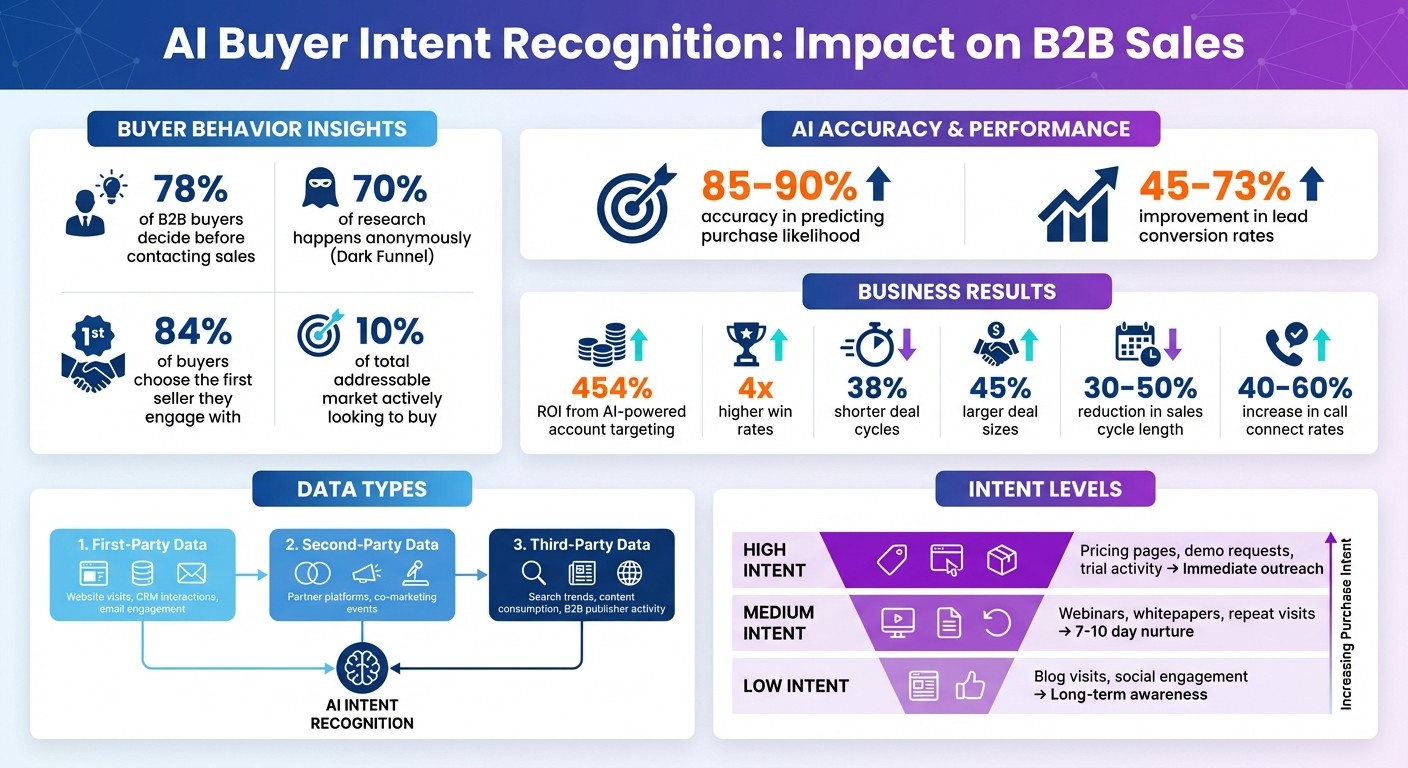
AI Buyer Intent Recognition: Key Statistics and ROI Impact
Understanding Buyer Intent Data
Types of Buyer Intent Data
Buyer intent data comes in three main forms: first-party, second-party, and third-party.
First-party data is gathered directly from your own platforms, such as website visits, CRM interactions, and email engagement. This type of data is considered highly reliable because it’s collected in real-time, offers large volumes, and is directly tied to your audience. Second-party data, on the other hand, comes from partnerships with other companies. For example, review platforms like G2 or co-marketing events, such as webinars, can provide access to another company’s first-party data. Lastly, third-party data aggregates broader behavioral signals from across the internet. This includes activity from B2B publishers, search trends, and content consumption patterns, helping to uncover the "Dark Funnel" - the anonymous portion of the buyer’s journey, which accounts for 57% to 70% of decision-making.
AI uses both explicit signals (like demo requests) and implicit signals (like how far someone scrolls on a page) to gauge a prospect’s readiness. What makes AI so effective here is its ability to connect subtle "micro-behaviors" to predict intent, even before a prospect takes a clear action.
By combining these data types, AI models are trained on a rich, multidimensional dataset, enabling them to better understand and predict buyer behavior.
Data Sources for AI Training
The best AI systems rely on a mix of data sources to paint a complete picture of buyer intent.
First-party sources include website analytics (e.g., tracking pages visited and time spent), CRM data (e.g., past interactions and deal history), and product usage data (e.g., trial activity or freemium engagement). These inputs are especially useful for real-time scoring models.
Third-party sources provide insights from intent feeds, which monitor keyword searches, content consumption across publisher networks, and technographic data (showing what software a company uses). Social media engagement with industry-specific topics also falls into this category. These third-party signals are particularly helpful for identifying new opportunities in emerging markets.
Public signals like job postings, company news, or SEC filings can highlight key moments, such as growth phases or strategic shifts, that signal potential buying opportunities.
Modern AI tools integrate these diverse data streams using platforms like Apache Kafka or Amazon Kinesis. This setup ensures real-time updates to intent scores, which is crucial since 84% of buyers choose the first seller they engage with.
By leveraging this combination of data, AI can link behavioral patterns to actionable insights about buyer intent.
Connecting Behavioral Patterns to Intent
AI excels at identifying patterns in buyer behavior that reveal true intent. It takes raw actions - such as how long someone spends on a case study or the sequence of content they consume - and translates them into meaningful insights about their likelihood to purchase.
To evaluate intent, AI looks at three key dimensions:
Frequency: How often a prospect engages with your content.
Recency: How close together their actions occur.
Depth: The complexity or significance of the content they interact with.
For instance, a prospect who downloads several whitepapers in a short timeframe and attends a webinar demonstrates much stronger intent than someone who casually reads a blog post and disappears.
Machine learning models like Neural Networks and Random Forests are particularly effective at spotting these patterns. They can identify when a prospect’s behavior mirrors that of previous successful buyers, even if the specific actions differ. This allows AI to predict purchase intent with a high degree of accuracy.
The result? A segmented lead list that prioritizes prospects based on their intent:
High intent: Actions like visiting pricing pages, requesting demos, or trial activity signal readiness for immediate outreach.
Medium intent: Behaviors such as attending webinars, downloading whitepapers, or revisiting your site multiple times suggest they need more nurturing through value-driven content.
Low intent: Casual actions like browsing blogs or engaging on social media indicate they’re better suited for soft-touch brand awareness efforts.
AI Models for Buyer Intent Recognition
Machine Learning Models for Intent Recognition
AI models designed to recognize buyer intent generally fall into three categories: supervised learning for lead scoring, unsupervised clustering for segmentation, and time-series models for tracking how intent evolves throughout a buyer’s journey.
Neural networks and deep learning models are particularly adept at identifying complex, non-linear patterns in behavioral data. For instance, Multi-Layer Perceptrons (MLPs) process raw data to generate intent scores, while Convolutional Neural Networks (CNNs) excel at identifying sequential patterns in user behavior. When it comes to time-series analysis, Recurrent Neural Networks (RNNs) - especially Long Short-Term Memory (LSTM) and Gated Recurrent Units (GRU) - are used to monitor how a prospect’s intent changes over weeks or even months.
Other machine learning methods like Random Forest and ensemble techniques rank feature importance, helping to pinpoint the signals that most accurately predict buyer intent. Gradient Boosting algorithms, such as XGBoost and LightGBM, stand out for their speed and efficiency, making them ideal for managing high-volume transactional sales. Support Vector Machines (SVMs) also play a role, categorizing prospects into different intent levels by identifying optimal boundaries between datasets.
Natural Language Processing (NLP) adds another layer of precision. Transformer models like BERT and GPT analyze text-based inputs from sources like emails, social media posts, and job listings to classify intent as research-driven or purchase-oriented. Modern buyer intent tools, leveraging these models, achieve impressive accuracy rates of 85–90% in predicting purchase likelihood by continuously learning from behavioral patterns.
These advanced AI models lay the groundwork for refined feature engineering, enabling sales teams to better interpret and act on buyer signals.
Feature Engineering for Sales Intent
Feature engineering transforms raw digital activity into actionable buying signals, helping to distinguish between casual interest and serious purchasing intent. Instead of relying on arbitrary point systems, AI leverages patterns derived from thousands of previous buyers who transitioned from research to purchase.
Key features include engagement depth metrics like scroll depth, dwell time, and video completion rates, which indicate active evaluation rather than passive browsing. Temporal patterns, such as the recency of a user’s last visit or the frequency of their actions within a short time frame, can signal urgency or in-market behavior. Content sequence analysis tracks movement from top-of-funnel assets (like blog posts) to bottom-of-funnel materials (such as pricing pages or ROI calculators), revealing readiness to make a purchase.
At the account level, aggregated signals from multiple individuals within the same organization can indicate the involvement of a buying committee. For instance, if several employees from the same company visit your site within a short period, this often points to coordinated decision-making. Additionally, micro-interactions - such as mouse movements, specific clicks, and exit intent - provide real-time insights that help differentiate genuine buyers from bots or casual browsers.
How Coldreach Identifies Buyer Intent
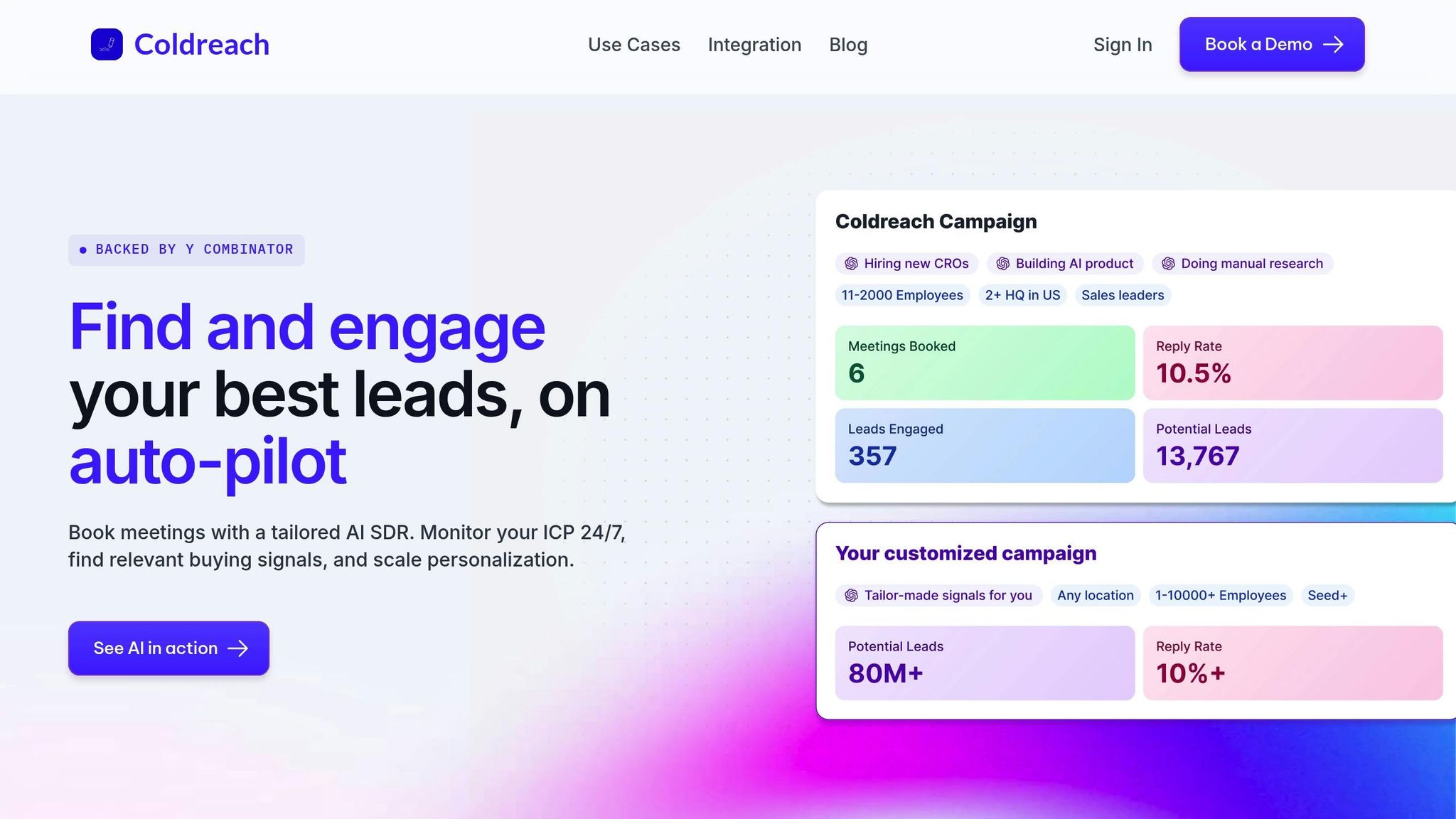
Coldreach takes a different approach to buyer intent by focusing on operational bottlenecks rather than solely tracking traditional buying signals. This strategy goes beyond monitoring common indicators like new funding rounds or leadership changes, which, while useful, occur infrequently. Instead, Coldreach identifies everyday operational challenges that companies face but rarely make public.
The platform analyzes 4–5 years of job history across 97 million companies. For example, if a company repeatedly posts operational roles that deviate from typical hiring trends, Coldreach interprets this as a sign of an internal bottleneck. It then generates an email tailored to that specific inefficiency, explaining how your solution can address the issue. This approach enables sales teams to scale outreach while maintaining relevance, uncovering leads that may not have explicitly signaled intent to buy but are likely in need of a solution. As a result, it drives measurable improvements in sales performance and boosts conversion rates.
Training and Deploying Intent Models
Training Process for Buyer Intent Models
To kick off buyer intent modeling, start by establishing a unified data pipeline. This pipeline should seamlessly connect your CRM, marketing automation tools, website analytics, and any third-party data sources you’re using.
The first step is data collection. Gather first-party, third-party, and cooperative data, then clean it by removing duplicates and outdated records. Next, define outcome labels that represent successful conversions - this step is crucial because these labels act as the model’s target for optimization.
When selecting algorithms, match them to the complexity of your sales process. For non-linear patterns, neural networks work well. Random Forest is useful for ranking features, while NLP models are ideal for analyzing text-based signals. Train the model using 12–18 months of labeled historical data, but keep a portion of it aside for validation. Before deployment, evaluate the model’s performance by checking metrics like precision, recall, and F1 scores.
Once deployed, continuous monitoring is essential. Feed the model with fresh data to avoid drift and aim to maintain an accuracy rate of 85–90%. These models ultimately fuel the behavioral rules that enable precise and timely outreach.
Behavioral Rules for AI SDR Agents
Once your models are trained, the next step is setting up behavioral rules to guide AI SDR (Sales Development Representative) outreach. Intent scores become the foundation for decision-making, determining when, how, and how often an AI SDR agent should reach out.
Prospects can be divided into three intent tiers:
High-intent prospects: These include individuals who visit pricing pages, request demos, or use free trials. They should receive immediate outreach - preferably within one hour - along with direct booking links.
Medium-intent prospects: This group covers actions like downloading whitepapers, attending webinars, or making repeat visits. A value-driven approach works best here, with outreach scheduled every 7–10 days and featuring case studies.
Low-intent prospects: These are individuals who engage minimally, such as visiting a single blog post or liking a social media post. They should be included in a long-term nurture track focused on building awareness.
Timing is critical. Studies show that 84% of buyers go with the first seller who contacts them. AI SDR agents leverage real-time processing - often through tools like Apache Kafka - to analyze micro-behavioral signals as they occur. This allows for immediate action when intent spikes.
Coldreach, for example, uses these behavioral rules to monitor operational inefficiencies across 97 million companies. When the AI identifies patterns, such as repeated hiring for specific roles, it triggers personalized outreach. By referencing these inefficiencies directly, the messaging stays relevant and avoids generic pitches.
Governance and Compliance in AI Training
Compliance with privacy laws like GDPR and CCPA is non-negotiable when collecting first-party data. Use consent management systems to automate opt-ins for behavioral tracking across your digital platforms.
Only collect the data you truly need, anonymize personal identifiers, and ensure you support user rights like the "Right to Deletion." Regularly monitor for bias by conducting automated checks and periodic audits. For decisions with high stakes, maintain human oversight to catch biases that automated systems might miss.
"Ethical considerations and privacy compliance are essential in intent data collection, particularly for first-party data. You must obtain prior and explicit consent from the user, aligning with GDPR and CCPA statutory requirements." - The 6sense Team
Perform quarterly audits to assess data quality, integration performance, and adherence to privacy-first policies. When preparing for intent-driven outreach, check your databases against global Do Not Call (DNC) lists. These governance practices not only protect the integrity of your models but also enhance their effectiveness in real-time sales outreach.
Measuring the Impact of Buyer Intent AI
Performance Metrics for Intent Models
To gauge how well your AI is identifying buyer intent, start by tracking match rates. This metric shows how accurately the AI links anonymous signals to known accounts, giving insight into its ability to uncover activity within the Dark Funnel - where 57–70% of buyer activity happens.
Next, evaluate the frequency, recency, and depth of the signals. Frequency looks at how often specific behaviors occur, recency measures how close in time those actions happen, and depth examines the progression of engagement - from reading blog posts to interacting with ROI calculators. Together, these factors help differentiate serious buying interest from casual browsing.
Another critical metric is lead prioritization accuracy. AI models rank leads based on their likelihood to convert, leveraging historical data from thousands of successful buyers. Unlike traditional lead scoring, which often relies on arbitrary points, these models use pattern recognition to identify behaviors that signal readiness to buy. The ultimate measure of success? A boost in conversion rates - more leads turning into actual opportunities after adopting AI-driven intent models. These metrics directly translate into measurable business outcomes.
Business Results from Intent-Driven AI
The numbers speak for themselves: Businesses leveraging AI for targeting accounts report a 454% ROI, 4x higher win rates, 38% shorter deal cycles, and 45% larger deals.
Speed is another major advantage. With 84% of buyers making their purchase from the first seller they engage with, being quick to act is everything. Intent-driven AI helps narrow your focus to the roughly 10% of your total addressable market that’s actively looking to buy. This precision ensures your efforts are concentrated on accounts that matter, rather than wasting resources on uninterested prospects.
Additionally, keep an eye on your cost per acquisition (CAC). By targeting accounts showing genuine intent, you’ll likely see a significant drop in marketing and sales costs per customer. Focused efforts mean less time and money spent chasing cold leads.
Coldreach's Performance Data
Coldreach’s data shows how these principles play out in practice, delivering impressive results for its clients. By combining advanced intent and behavioral metrics with robust outreach strategies, Coldreach drives powerful campaign outcomes.
For example, Coldreach boasts a 3.8%+ average reply rate across client campaigns - far exceeding the industry average of less than 1%. This success stems from meticulous research across 97 million companies and an email infrastructure designed to land messages in primary inboxes.
This year alone, Coldreach sent over 3 million emails, resulting in more than 400 booked meetings. One staffing client, for instance, sent 1,768 emails, received 103 replies, and converted 34 leads - proof of the effectiveness of precise intent targeting.
Even in high-trust industries like Fortune 500 cybersecurity, Coldreach maintains reply rates above 3%. Their ability to connect with CISOs highlights both the reliability of their email delivery and the relevance of their messaging.
What sets Coldreach apart is its focus on the "Status Quo" - the often-overlooked cost of inaction. By identifying subtle yet critical patterns, Coldreach scales outreach without compromising on relevance. This ensures that your efforts reach the right leads, even those who haven’t openly expressed their intent yet.
Conclusion
Key Takeaways
AI-powered intent models are reshaping sales strategies by delivering an impressive 85–90% accuracy in predicting purchase likelihood and improving lead qualification rates by 45–73%. This accuracy comes from AI's ability to analyze subtle behaviors - like scroll depth, dwell time, and keyword usage - rather than depending solely on explicit actions like form submissions.
By detecting intent early in the "Dark Funnel", your team can engage prospects before they reach out. This is critical, as 84% of B2B buyers choose the first seller they contact. Companies using AI intent systems often experience 30–50% shorter sales cycles and a 40–60% increase in call connect rates. Focusing on high-intent accounts allows sales teams to direct their efforts toward the 10% of leads that drive 90% of results, enabling precise and impactful action.
Next Steps for Sales Teams
Sales teams can turn these insights into action by refining data integration and lead segmentation. Start by combining first-party and third-party data within your CRM. First-party behavioral data offers real-time precision, while third-party signals provide a broader market perspective. Automate workflows to respond to high-intent actions - like visits to pricing pages or demo requests - within an hour to stay ahead of competitors.
Organize your leads by intent level in your CRM. High-intent prospects should receive immediate attention with booking links and proposals, while medium-intent leads benefit from targeted educational content. For low-intent contacts, focus on passive brand awareness to keep your company top-of-mind. Acting on these early AI-driven signals ensures your team connects with prospects before the competition.
To scale personalized outreach, Coldreach offers a comprehensive solution. By tracking 97 million companies and analyzing trends - such as repeated job postings for manual roles - Coldreach identifies prospects facing operational challenges who could benefit from your solution, even if they're not actively seeking it. Its managed infrastructure ensures primary inbox placement and consistently achieves reply rates above industry averages. With over 3 million emails sent and 400+ meetings booked this year, Coldreach proves that AI-driven intent recognition can deliver tangible sales outcomes.
FAQs
×
How does AI accurately identify when a buyer is ready to make a purchase?
AI figures out buyer intent by diving into a massive pool of behavioral data - things like website visits, search terms, social media activity, and even job postings. It uses machine learning to spot patterns that separate casual browsers from serious buyers. The best part? These models keep learning from real-time data, so they can quickly adjust to new signals.
What makes this approach so effective is the mix of real-time behavioral insights and in-depth historical analysis. Take Coldreach, for instance. Its AI digs through years of job-posting data to find operational gaps, such as a company frequently hiring for "Data Entry" roles. This kind of pattern reveals underlying issues that might need a solution, even if the company hasn’t openly shown interest yet. By combining these layers of data with predictive algorithms, AI pinpoints high-intent prospects with impressive accuracy.
×
What data is essential for training AI to recognize buyer intent?
Training AI to recognize buyer intent hinges on analyzing detailed, behavior-based data that indicates how ready a prospect is to make a purchase. Key data sources include website activity (like page views, time spent on pages, downloads, and navigation patterns), content engagement (such as signing up for webinars, reading eBooks, or watching videos), and search behavior (keywords that suggest active research). On top of that, social media interactions can provide clues through mentions or other activity tied to potential interest.
To improve precision, AI models also incorporate firmographic data (like company size, industry, and job roles) and historical patterns (for example, repeated job postings for certain roles) to uncover operational challenges that may point to specific needs. By blending these real-time behavioral signals with contextual insights, AI can separate serious buyers from casual browsers more effectively.
Take Coldreach, for instance. It analyzes the online behavior of over 97 million companies to uncover hidden challenges - such as inefficiencies or unmet needs - and predicts intent even before a prospect explicitly shows interest. This method allows for sharper targeting and improved sales results.
×
How can sales teams use AI to identify and act on buyer intent more effectively?
AI empowers sales teams to identify buyer intent by analyzing behavioral cues like website visits, content downloads, and even hiring trends. By assigning intent scores based on these actions, sales teams can prioritize leads with the highest likelihood of converting. This means prospects showing strong intent can be fast-tracked for outreach, while others are placed in nurturing campaigns until they're ready.
Once intent is clear, AI steps in to create personalized messages that directly address specific challenges. For example, if a company is actively hiring for multiple "Data Entry" positions, AI can craft an email suggesting how automation tools could simplify their workflows. This eliminates the need for manual research, enabling sales reps to send tailored, impactful emails at scale.
Incorporating intent data into daily workflows - like automating lead prioritization and refining AI models with team feedback - helps sales teams zero in on the best opportunities. This approach not only boosts conversion rates but also shortens the sales cycle. By combining precise intent insights with targeted outreach, teams can make the most of their resources and drive better results.