

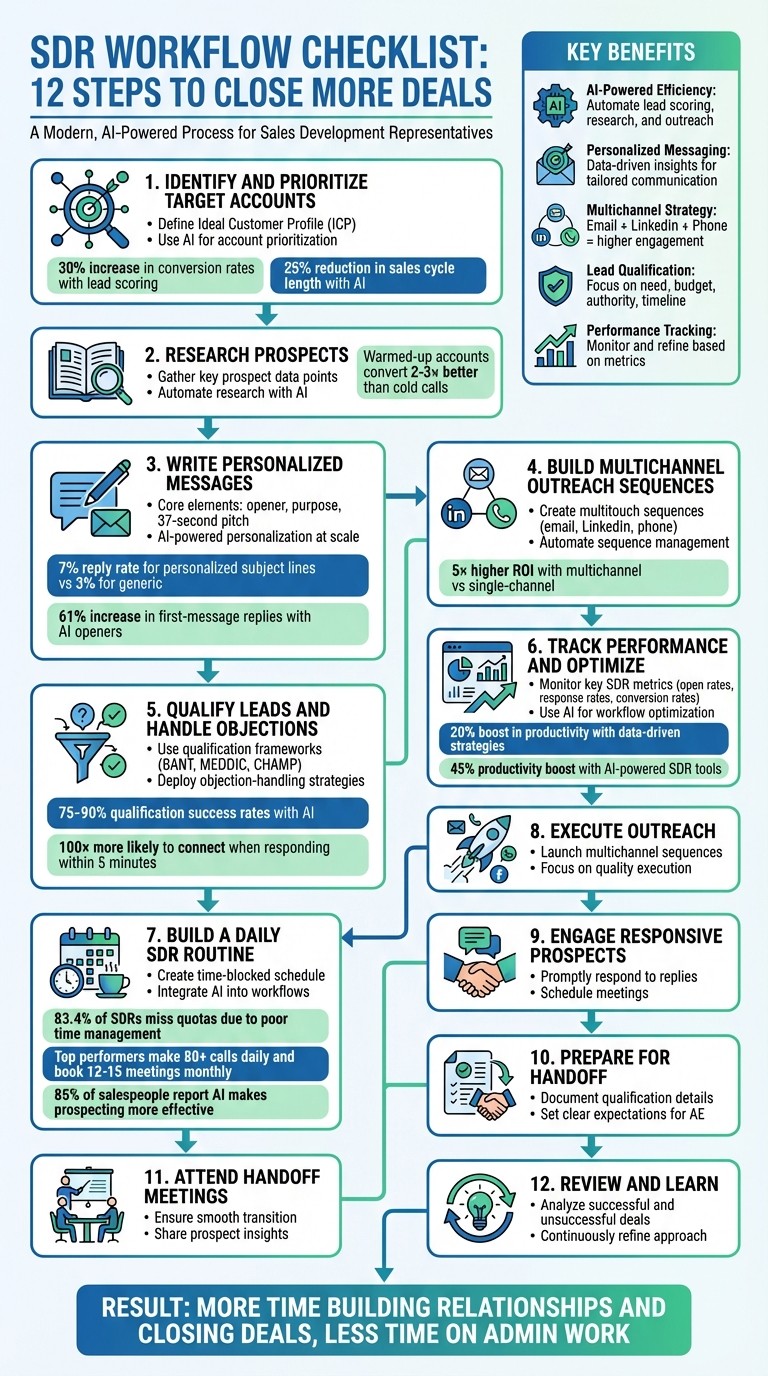
Struggling to close more deals? Here’s the solution: a structured workflow for SDRs that combines efficient processes with AI tools to save time and improve results.
Sales Development Representatives (SDRs) often lose valuable hours on manual tasks like lead qualification, research, and outreach. This checklist outlines 12 actionable steps to streamline your workflow, prioritize leads, and personalize outreach - helping you convert more prospects into customers.
Key Highlights:
AI-Powered Efficiency: Automate lead scoring, research, and outreach to save time and boost productivity.
Personalized Messaging: Use data-driven insights to craft tailored emails and calls that resonate with prospects.
Multichannel Strategy: Combine email, LinkedIn, and phone outreach for higher engagement.
Lead Qualification: Focus on prospects with the right need, budget, and timeline to maximize your efforts.
Performance Tracking: Monitor key metrics like open rates and response rates to refine your approach.
This checklist ensures SDRs spend less time on admin work and more time building relationships and closing deals.
Step 1: Identify and Prioritize Target Accounts
Define Your Ideal Customer Profile (ICP)
Start by crafting your Ideal Customer Profile (ICP) to zero in on the companies most likely to convert into loyal customers. An ICP is essentially a blueprint of your ideal client, detailing the characteristics that make them a perfect fit for your product or service. Without this clarity, you could end up chasing leads that go nowhere.
To create an effective ICP, focus on specific qualifiers like firmographics, demographics, and behaviors. Think about factors such as industry type, geographic location, company size, technology stack, business challenges, pain points, and decision-making roles. For instance, if you’re selling marketing automation software, your ICP might target B2B SaaS companies with 50–200 employees located in the United States.
Why is this so important? Companies that use lead scoring based on ICP criteria see conversion rates jump by 30% [2]. A clearly defined ICP doesn’t just help you focus your efforts - it makes the entire sales process smoother and more effective.
Use AI for Account Prioritization
Once your ICP is locked in, let AI take the reins for account prioritization. Instead of manually sifting through endless company data, AI tools can evaluate and rank accounts automatically based on how well they align with your ICP and their likelihood to convert [2].
Take Coldreach, for example. This platform scans a massive database of 97 million companies to identify "status quo signals" that hint at immediate needs for your product. Let’s say a company has posted three "Data Entry" job openings in the past year - AI might flag this as a sign of an operational bottleneck that your solution can solve. This method allows you to pinpoint high-potential accounts, even if they haven’t explicitly expressed a need, helping you scale your outreach efforts without losing relevance.
The impact of AI is hard to ignore: sales teams using these tools often see a 25% reduction in sales cycle length and a 15% boost in productivity [2]. By leveraging AI insights, you’ll be better prepared to dive into the next stage of prospect research with precision and efficiency.
Step 2: Research Prospects
Key Prospect Data Points
Once you've prioritized your target accounts, the next move is digging deeper into individual prospects. This isn't just about gathering contact information - it's about truly understanding both the person and the company they represent.
Start by examining the prospect's role. For instance, a VP of Sales may face different challenges compared to a Sales Operations Manager. Understanding their responsibilities can help you anticipate their pain points and priorities [7][9].
Next, look at their activity history and engagement with your content. Are they attending webinars? Downloading specific resources? These behaviors can reveal what topics resonate with them and hint at their current challenges [4][5][9]. Also, don’t overlook their social media activity - it can offer timely insights into their interests or recent initiatives [8][9].
On the company side, focus on firmographic details like company size, industry, and revenue to ensure they align with your Ideal Customer Profile [5][6][9]. Investigate their tech stack to spot potential integration opportunities. Check for recent funding rounds, which could indicate new budgets, and track company news, such as product launches or leadership changes, which can serve as great conversation starters [4][5][8][9]. Identifying operational challenges within the company can also highlight areas where your solution could make a meaningful impact.
Gathering this level of detail allows you to craft outreach that's not only precise but also highly relevant, setting the stage for stronger connections and a more effective sales strategy.
Automate Prospect Research with AI
Once you've identified what data to collect, AI can make the process faster and more efficient. Manual research can eat up hours of a sales rep's time, but AI tools can analyze massive datasets in minutes, giving you the insights you need without the time drain [10]. For example, Coldreach scans data from 97 million companies to identify "status quo signals", helping you pinpoint needs before prospects even voice them.
As Kraig Kleeman, Founder and CEO of TheSalesCadence.com, puts it: "There is incredible power in leading with research and leading with relevance" [11].
And here's the kicker: research shows that calls to warmed-up accounts convert 2–3 times better than cold calls [12]. By leveraging AI-driven insights, your outreach becomes more targeted, relevant, and effective.
Step 3: Write Personalized Messages
Core Elements of Effective Messaging
When it comes to messaging that actually secures meetings, the secret lies in crafting sharp, clear, and focused communication. Your outreach should grab attention and make it easy for the recipient to say "yes" to a meeting.
Start with a standout opener. Research shows that small tweaks make a big difference - using "How've you been?" leads to a 6.6× higher success rate, while "How are you?" performs 3.4× better. After your opener, dive straight into the purpose of your message. Phrases like "The reason for my call is…" can increase your success rate by 2.1×. Prospects want clarity about why you're reaching out, whether it’s related to a recent expansion, a challenge they’re facing, or another timely milestone. As Gong Labs explains:
"People crave knowing why something's happening, even if it's a weak reason. So tell them why you're calling (after you've rehearsed it 1,000 times). Be darn sure you're succinct and clear."
– Gong Labs
Keep your pitch around 37 seconds. Messages shorter than 25 seconds are much less likely to secure meetings. And don’t forget to include risk-reversal language, like "cancel anytime" or "30-day opt out", which can improve win rates by 31%. [13]
Once you’ve nailed these elements, you can take your messaging to the next level by incorporating AI to scale personalization effectively.
AI-Powered Personalization at Scale
AI tools are game-changers when it comes to keeping your outreach personal, even when you’re operating at scale. After you’ve crafted your initial message, AI ensures every prospect feels like you’re speaking directly to them.
By analyzing massive datasets - like purchase history, website activity, job titles, company growth, and social media behavior - AI identifies patterns and generates tailored messages. [14][15][16] For example, personalized subject lines can more than double reply rates (7% compared to 3% for generic ones), while AI-generated openers can increase first-message replies by 61%. Companies that use AI for personalized outreach report a 66% boost in sales team productivity, with emails achieving 50% higher open rates and a sixfold increase in close rates. [17][18]
Coldreach takes this a step further by creating custom plain-text emails that reference specific operational inefficiencies uncovered during research. These plain-text emails are less likely to trigger spam filters, landing directly in the primary inbox and delivering consistent reply rates of 3.8% or higher. The focus here isn’t on sending more emails - it’s about sending better ones.
"Generic 'growth challenges' templates get deleted. But when your CRM auto-populates specific references to recipient pain points based on enriched data, those emails get read and forwarded to stakeholders."
– Artisan [17]
The trick is to map CRM fields like industry, job title, and recent activity to your campaigns. Use personalization shortcodes to automatically insert relevant details into subject lines and introductions. This way, every message feels thoughtfully written - even when you’re reaching out to hundreds of prospects at once.
Step 4: Build Multichannel Outreach Sequences
Create an Effective Multitouch Sequence
Once you've nailed down personalized messaging, it's time to take things up a notch with a coordinated multichannel outreach strategy.
Why stick to just one channel when your prospects are active across several? Multichannel campaigns can deliver nearly 5× higher ROI compared to single-channel efforts [20]. That’s why combining email, LinkedIn, and phone calls is a must. The key is to create a sequence where each touchpoint builds on the last. For instance, you could start with an email introduction, follow up with a LinkedIn connection request referencing that email, and then make a phone call a few days later.
Tailor your approach based on your audience. Executives might respond better to phone calls and LinkedIn messages, while mid-level managers may prefer email communication. Keep your messaging fresh and relevant to each touchpoint, ensuring it aligns with how your audience prefers to engage.
Automate Sequence Management with AI
Trying to manage multichannel outreach manually? That’s a recipe for burning valuable time. AI can take over the repetitive tasks, letting you focus on what matters most [19]. Tools like Coldreach streamline the process by integrating email, LinkedIn, and phone outreach into one cohesive system. This ensures your messaging stays consistent and well-coordinated across all platforms.
AI doesn’t just handle the logistics - it also personalizes your outreach using real-time data, so your messages hit the mark. Features like email warm-up, inbox rotation, and detailed analytics ensure your emails land in the right inboxes and provide insights into engagement levels. And when a high-priority lead bites, you can step in manually to seal the deal while staying in full control.
Step 5: Qualify Leads and Handle Objections
Lead Qualification Frameworks
Spend your time where it counts - on leads that are most likely to convert. Lead qualification helps you figure out if a prospect has the need, budget, authority, and timeline to make a purchase [66–71].
One of the most well-known frameworks is BANT (Budget, Authority, Need, Timeline). It’s straightforward: Does the prospect have the funds? Are they in a position to approve the deal? Do they genuinely need your product or service? And when are they planning to make a decision? While BANT is a solid starting point, modern sales often focus less on ticking boxes and more on understanding the prospect’s priorities and building meaningful relationships [66–71]. Frameworks like MEDDIC or CHAMP might better fit your specific sales process, but the idea is the same - qualify early and keep refining as you go.
AI tools can make this process faster and more efficient. For example, platforms like Coldreach analyze prospect data in real time, allowing you to prioritize leads based on key criteria. Some AI systems can achieve qualification success rates of 75–90% and handle up to 90% of calls without needing human input [21]. This means you can avoid wasting time on leads that won’t convert and spend more energy closing deals with the right prospects.
Once you’ve qualified a lead, the next challenge is addressing any concerns they might have.
Objection-Handling Strategies
When prospects raise objections - whether about timing, budget, or relevance - it’s important to slow down and listen carefully. The best sales reps don’t rush to respond; instead, they adjust their pace and address concerns with calm confidence [24].
Start by clarifying the issue. Use techniques like mirroring, where you repeat the prospect’s last few words, or ask questions like, “Can you help me understand what’s behind that concern?” to ensure you’re tackling the real problem [24]. Acknowledge their concern to build trust. Even a simple response like, “I completely understand why that’s on your mind,” can make a big difference [78–81]. After that, isolate the objection by asking if resolving that specific issue would make them comfortable moving forward. This approach helps you avoid getting sidetracked by unrelated concerns [24].
AI can also step in to handle objections, particularly during high-volume outreach. Companies that respond to leads within five minutes are 100 times more likely to connect and 21 times more likely to qualify them [3]. AI-powered sales development reps (SDRs) work around the clock, with average response times of just 500 milliseconds. They can answer basic questions about pricing or product features without any human involvement [3][21]. For more complex issues, like security concerns or custom use cases, AI systems gather all the necessary context before passing the conversation to a human rep [72–74]. To make the most of AI, set up clear objection-handling protocols, define when and how conversations should be handed off, and regularly review transcripts to fine-tune its performance [21][22][23].
Step 6: Track Performance and Optimize
Key SDR Metrics to Monitor
After leveraging AI to enhance outreach, the next step is keeping a close eye on the right metrics to fine-tune your strategy. It's not just about counting activities anymore. Focus on engagement metrics like email open rates, response rates, and call connection rates, alongside conversion metrics such as qualified meetings and deal values. These provide a direct line of sight into how close you are to sealing the deal[25][26][27].
Here's a compelling stat: data-driven sales strategies can lead to a 20% boost in productivity and a 15–30% increase in conversion rates[29]. Yet, on average, SDRs spend just 22% of their time in actual sales conversations, with much of their day lost to tasks like data entry and research[28]. Monitoring these metrics can help pinpoint inefficiencies and refine your team's workflow.
Use Coldreach for Workflow Optimization
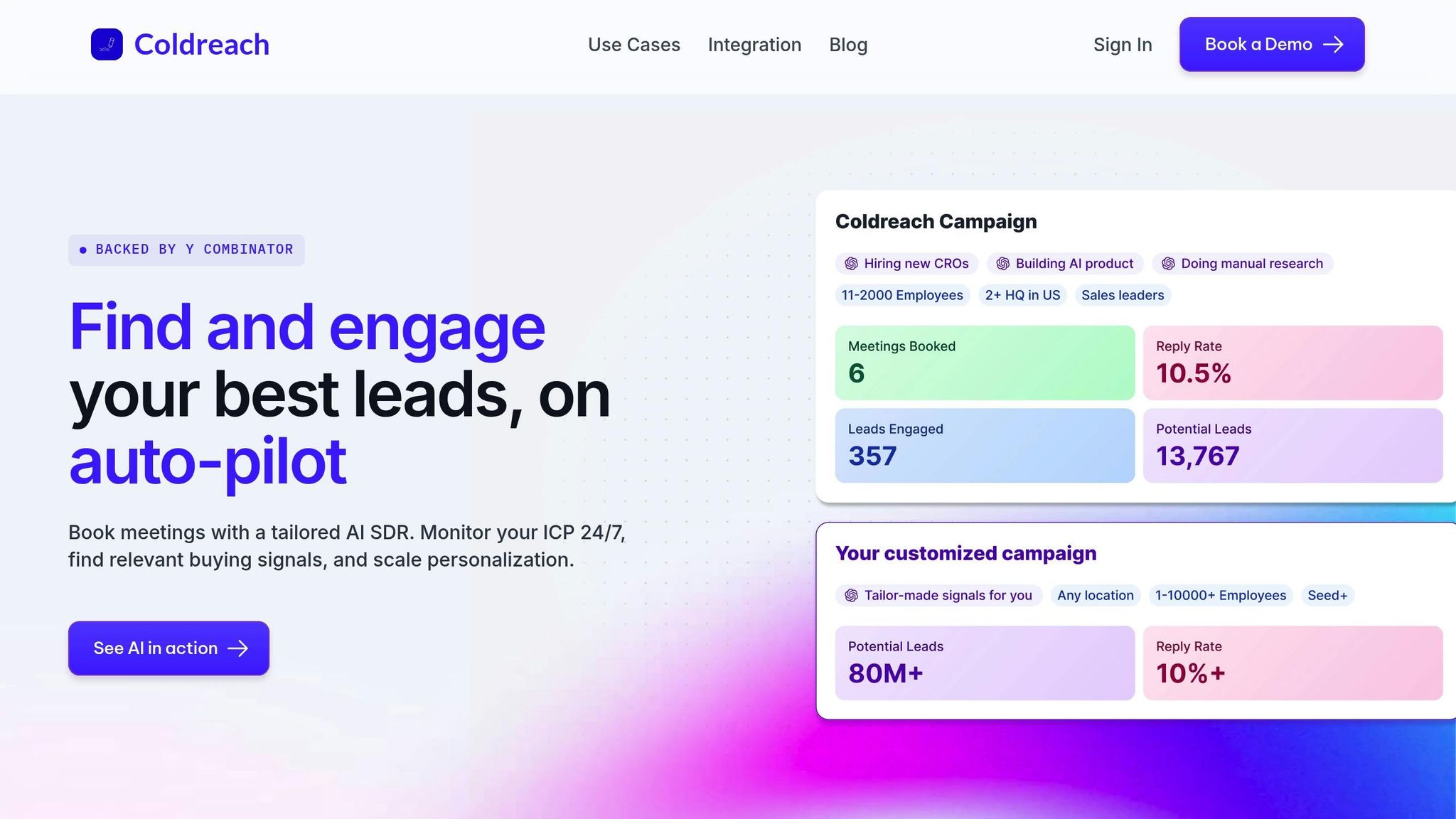
Coldreach takes these insights to the next level by continuously improving lead scoring and qualification based on deal outcomes and team feedback[28][29][30]. It tracks every interaction and syncs the data with your CRM, giving your sales team a crystal-clear view of what’s working. This allows you to personalize outreach using real performance data[22].
AI-powered SDR tools like Coldreach can deliver a 45% productivity boost and improve lead qualification rates by 20%[28]. However, inaccurate data can throw a wrench in the system[30]. To avoid this, integrate third-party tools to catch errors early. Encourage your team to test different subject lines, messaging styles, and call strategies. Using these insights to refine your approach creates a feedback loop that keeps improving your outreach efforts over time[29].
Step 7: Build a Daily SDR Routine
Create a Time-Blocked SDR Schedule
A well-structured schedule is essential for hitting your sales goals. Did you know that 83.4% of SDRs miss their quotas each month? Poor time management is often to blame [33]. That’s where time blocking comes in. By dedicating specific chunks of time to focused tasks, you can stay on track and maximize productivity [31].
Focus on your prime prospecting hours by setting aside 2–3 hour blocks for cold calling, email sequences, and social selling. Aim for the start and end of the day, as these are typically when prospects are most responsive [35]. Top-performing SDRs make over 80 calls daily and book 12–15 meetings each month [32]. During these blocks, eliminate distractions - close your email and Slack, and check them only at designated times, such as 8:30 a.m., 12 p.m., and 3 p.m. [34].
To avoid wasting time on constant context switching, group similar tasks together. Dedicate one block to calls, another to emails, and set aside short, specific windows for CRM updates [32][34]. Save non-revenue-generating tasks like prospect research, list building, and internal meetings for times when prospects are less likely to engage [34][35]. With SDRs averaging just 3.6 quality conversations per day, every moment spent prospecting matters [32].
To take this routine even further, consider leveraging AI to streamline your workflow.
Integrate AI into SDR Workflows
Once you’ve built a time-blocked schedule, adding AI tools can make your day even more efficient. SDRs often spend up to 78% of their time on tasks like prospect research and list building - time that could be better spent on selling. Tools like Coldreach can handle these repetitive tasks, allowing you to focus on closing deals [8].
AI tools don’t just save time; they dramatically improve prospecting efficiency. In fact, 85% of salespeople report that AI has made their prospecting efforts more effective, and 79% say it gives them more time to sell [32]. By automating tasks like finding contact information, analyzing digital behavior, scoring leads, and crafting personalized emails, Coldreach helps you make the most of your prospecting blocks. This extra focus on high-value activities can drive an average annual pipeline value of $3 million [32].
AI in Sales: The EXACT Workflows That Save Us Hours Every Week
Conclusion
A well-structured SDR workflow isn’t just a nice-to-have - it’s the foundation for turning insights into predictable success. This 12-step checklist serves as a reliable framework to consistently engage buyers, close deals, and build habits that lead to quicker onboarding for new hires, smoother execution of your playbook, and a steady flow of high-quality leads. These leads, in turn, help speed up sales cycles and improve win rates [36].
Once you’ve established a structured approach, the next step is refining your targeting. Take your strategy to the next level by incorporating detailed growth indicators - like hiring trends or recent funding rounds - into your research. Additionally, map out the entire buying committee, which often includes five or more key roles. This ensures your messaging is tailored to resonate with every decision-maker and influencer involved [37].
Personalization at scale is no longer optional. Gone are the days when generic, placeholder emails could perform well. Hyper-personalized outreach ensures your communications align with your prospect’s immediate needs and reinforces the effectiveness of each checklist step [37].
AI tools like Coldreach simplify time-consuming tasks such as lead research, prospecting, and CRM updates, freeing up your time to focus on high-value activities like meaningful conversations and closing deals [1]. These tools not only enhance productivity but also make lead qualification more efficient [1].
FAQs
How do AI tools boost productivity for Sales Development Representatives (SDRs)?
AI tools are a game-changer for SDRs, helping them save time and work smarter by automating essential tasks like finding leads, ranking prospects, and tailoring outreach efforts on a large scale. These tools also simplify managing multi-channel campaigns, make CRM updates quicker, and boost email deliverability - resulting in faster connections and better response rates.
By cutting down on repetitive tasks and offering actionable insights, AI allows SDRs to concentrate on what truly matters: building relationships and closing deals. The result? Greater productivity and success.
What makes a personalized sales message effective?
An effective personalized sales message resonates with the prospect by demonstrating a clear understanding of their unique situation. This means referencing their industry, job role, or recent accomplishments, while addressing specific challenges they might be facing. It’s all about showing that you’ve done your homework and truly grasp their needs.
To make your message stand out, rely on timely, relevant insights backed by reliable data. Keep the tone professional but friendly - this balance helps build trust and encourages meaningful conversations.
Why is using multiple channels for outreach more effective than sticking to just one?
Using a variety of channels for outreach works better because it lets you reach prospects in the way they’re most comfortable - whether that’s through email, phone calls, social media, or other platforms. This multi-channel approach increases your chances of connecting by providing more opportunities for interaction and gradually building familiarity.
Expanding your outreach across different platforms also helps you grab attention in a competitive sales landscape. When prospects see your message pop up in multiple places, they’re more likely to notice and respond. This not only speeds up the sales process but also improves your chances of turning leads into customers.