
Artisan AI gets attention because it promises a full AI SDR, not another sales engagement add-on. That is exactly why buyers need a clear review before they talk to sales.
We looked at 100+ user signals, talked with founders and SDR leaders, and pulled out the parts that matter: pricing, setup, day-to-day workflow, common complaints, and where Artisan fits or does not fit. This is not a teardown. It is a buyer-side evaluation.
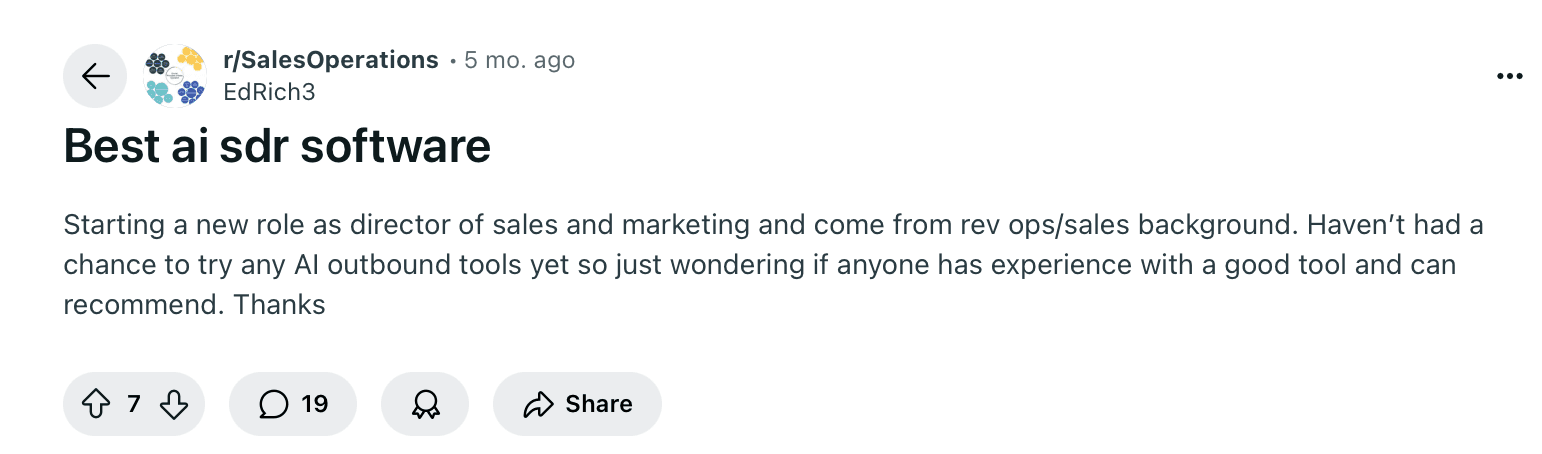
So I decided to dig in. Not just from the outside.
I spent 10+ hours going through 100+ real user reviews - from G2, Reddit threads, founder Slack groups, and cold outreach forums.
I’ve interviewed a few real users as well.
And what I found?
It’s not black and white. Artisan AI has its strengths, but also major gaps that early users are starting to call out.
I’m writing this not as a competitor trying to sell Coldreach.ai (though yeah, we solve the same problem).
I’m writing this as someone who’s been building in this space for years, has tested 7+ AI SDR tools, and has seen what makes or breaks cold outreach at scale.
Here’s the breakdown - brutally honest, no hype, no sugarcoating.
If you’re thinking about using Artisan AI, this will save you time, money, and inbox health.
Let’s get into it.
What is Artisan AI, and Who is Ava (And What Problem Are They Trying to Solve)?
Artisan positions itself as an AI SDR platform - meaning you don’t need to hire or train a sales rep.
Ava is an AI Sales Assistant who can write emails, follow up, and even reply to leads on your behalf.
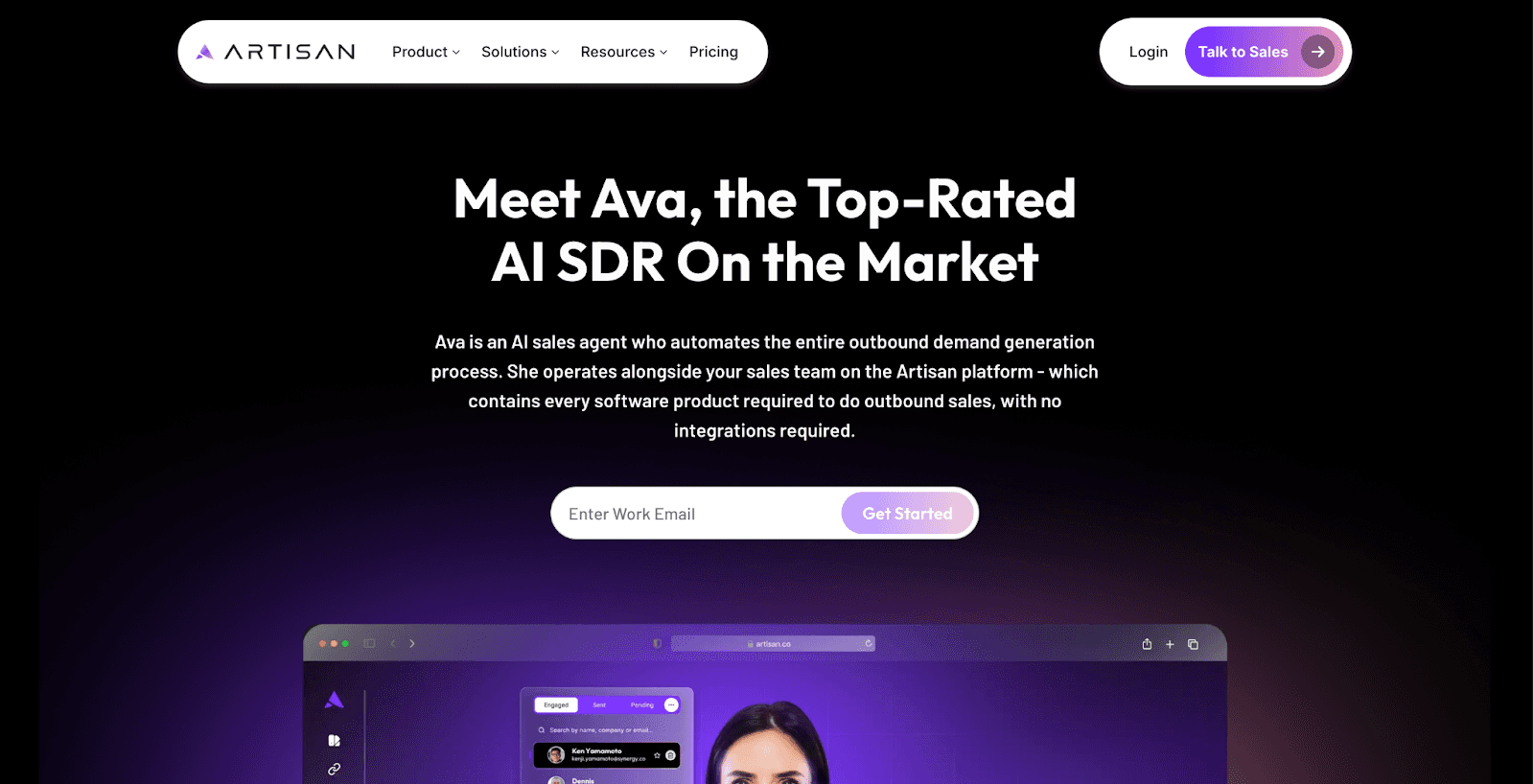
Sounds great in theory, right? Here’s what they promise:
“Ava handles 80% of your outbound so your team can focus on closing.”
The idea is to automate top-of-funnel sales work - prospecting, writing cold emails, and handling replies - without building a full SDR team.
For early-stage startups, solo founders, or lean sales teams, this can sound like a dream.
From what I’ve seen and tested, here’s the real play:
Ava is trained on cold email patterns and can run basic campaigns.
You give it your ICP and product details.
It spins up emails, follows up, and responds with GPT-style messaging.
You get metrics, meetings, or… sometimes confusion.
But let’s be clear: Artisan AI isn’t a full SDR replacement - it’s an automation layer over outbound workflows.
It tries to solve a big pain, not having the time or resources to do cold outreach consistently.
The catch? In trying to replace humans, it cuts corners.
And that shows up in the reviews - we’ll get into those next.
Why I Analyzed 100+ Artisan AI Reviews
Let me be clear - this isn’t about bashing Artisan AI. It’s about clarity.
As the founder of Coldreach.ai, I live and breathe outbound automation.
We've spent months refining how AI agents interact with leads, not just writing sequences, but making them feel human, intentional, and personalized.
But every time someone asks, “Should I use Artisan AI or just start with Coldreach?”
I realize they’re asking from a place of uncertainty, not feature comparison.
So I did the work.
I went through 100+ Artisan AI reviews across G2, Reddit, founder communities, and private Slack groups like RevOps or Belkins.
I spoke to users who tried Ava for 30–60 days.
I looked at patterns - what people loved, what annoyed them, and why some churned after a few months.
Why?
Because you deserve the real story, not a product pitch.
If Artisan AI is right for you, great. If not, I’ll help you understand why it falls short (and what to do instead).
Next, I’ll break down the most common themes from those 100+ reviews - the good, the bad, and the surprisingly honest.
Common Themes from Artisan AI Reviews (The Good, the Bad & the Brutal)
After going through 100+ Artisan AI reviews across G2, Reddit, and Slack groups, I noticed a pattern.
Most users fell into two camps:
(1) early excitement that fades within 30–60 days, and
(2) frustration around quality, control, and results.
Let me break down what people consistently liked, disliked, and warned others about.
✅ What Some Users Liked
Easy to get started: Multiple users said onboarding was smooth. If you’re non-technical, the UI and flow make it feel simple to launch your first campaign.
Early results (sometimes): A few G2 reviewers claimed to have booked 8–10 meetings in their first 2 months. But even they admitted success depended heavily on setup quality.
Decent for simple top-of-funnel activity: Some founders used Ava to get webinar signups or collect early-stage interest - not to book sales meetings directly.
❌ What Most Users Criticized
Zero replies after thousands of emails: One Redditor sent 1,400 emails and got 0 replies. Another confirmed the same - “not a single response.”
Feels like AI slop: Many users said the messages were clearly GPT-generated, overly generic, and lacked the depth needed for niche ICPs.
Low-quality lead sourcing: Ava struggles to find good-fit leads in specific markets. One user said Artisan returned just 3–7 C-level contacts from 3M+ records. That’s a red flag.
Buggy product experience: From DNS errors to broken warm-up timers to UI glitches, technical issues were frequent. Some users waited weeks for proper support.
Meetings didn’t turn into pipeline: A few users did get meetings, but those conversations didn’t convert. Leads were either cold or poorly qualified.
Salesy onboarding, underwhelming product: Several people said Artisan “sells the dream,” but what gets delivered is far from plug-and-play automation.
Direct Quotes from Real Users
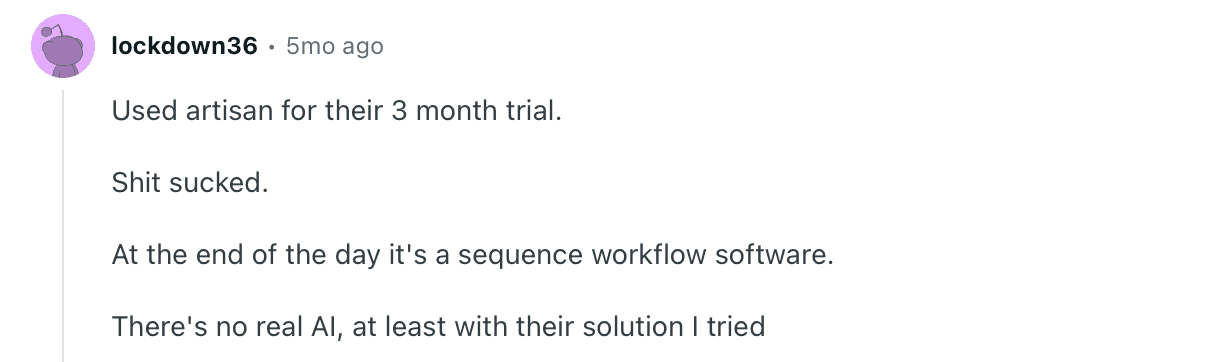
“Used Artisan for a trial. It's dog shit. It basically writes a sequence for you.”
- Reddit User, u/lockdown36
“~1,400 emails sent. 0 responses received.”
- Reddit User, u/CitizenJosh
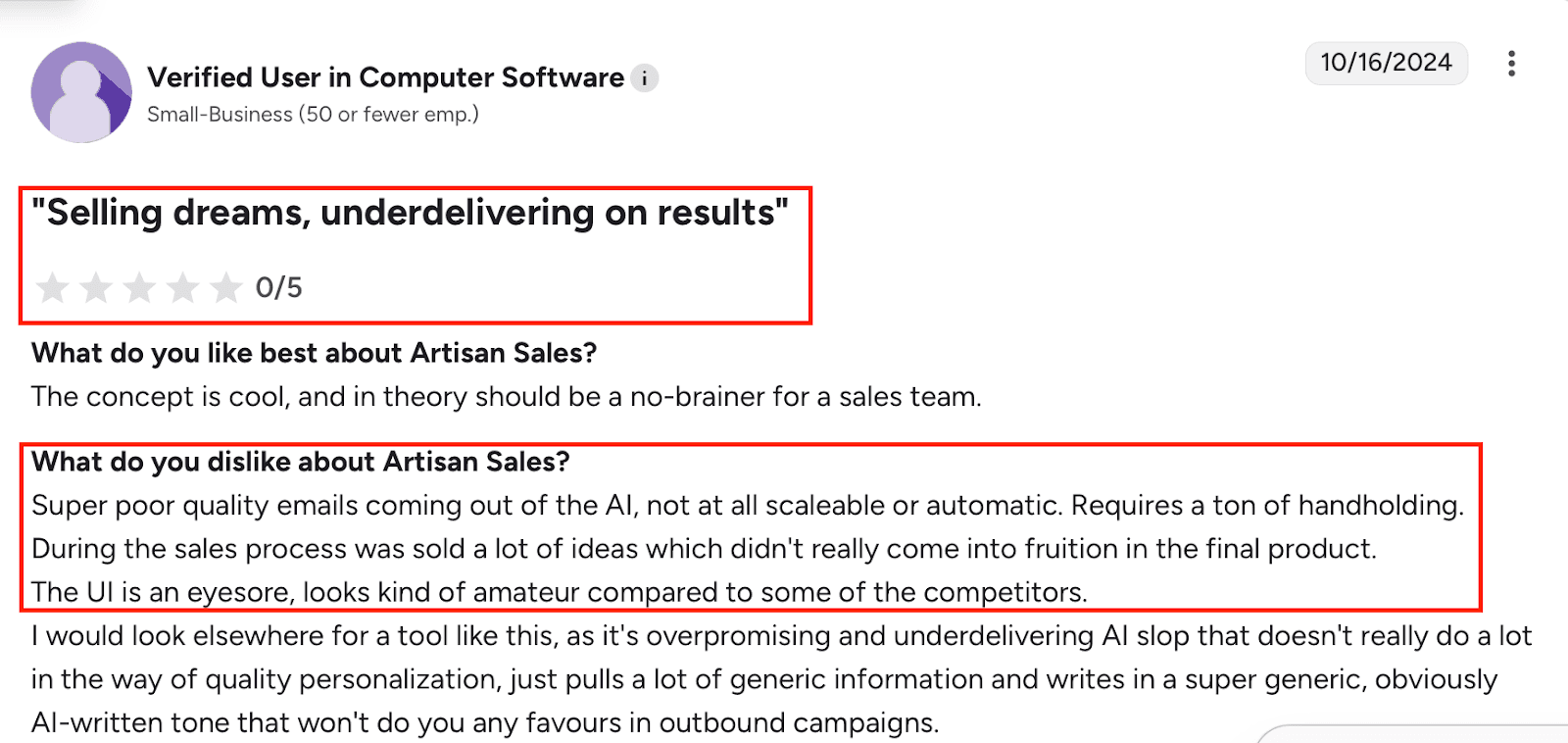
“Super poor quality emails… overpromising and underdelivering AI slop.”
- G2 Review, Oct 2024
“The support team helped us get it sorted… but it’s fragile. Not built for a mature GTM tech stack.”
- G2 Review, Mar 2026
“Honestly, a lot of these AI SDR tools are just marketing hype… a better bet is tracking job changes or signals.” (that’s what we are doing at Coldreach)
- Reddit User, Street-Device-3819
Artisan AI might help you test outbound cheaply.
But if you're serious about scaling outreach, getting replies, and protecting inbox health, you’ll hit a wall fast.
It’s fast… but fragile. Simple… but shallow. And for many users? Just not worth the risk.
What’s Missing in Artisan AI (That Actually Matters)
Look, every tool has trade-offs.
But when you promise “an AI SDR that replaces your outbound team,” the bar’s high.
And based on what I’ve seen both in user reviews and firsthand experience, building Coldreach that Artisan is skipping some critical pieces.
Here’s what’s missing under the hood:
1. Intent-Based Lead Prioritization
Artisan pulls leads, but it’s spray and pray.
No buying signals, no recency logic, no prioritization.
You get a static list. Whether those leads are hiring, engaging, or fit your ideal persona right now? Artisan doesn’t check.
“It’s Mad Libs with a logo.” - Actual Reddit comment
We (Coldreach.ai), on the other side, score and prioritize based on job changes, tech installs, post engagement, and firmographic fit.
You email the 20% that matter, not 1,000 random contacts.
2. Reply-Aware Sequences
Ava can send emails. But she can’t carry on conversations.
She doesn’t adjust tone based on replies.
She can’t prioritize warm replies vs cold ones.
No context memory across threads.
That means more dropped leads and more awkward follow-ups that kill trust.
3. No Control Over IPs, Domains, or Deliverability
If your sender reputation tanks, good luck.
Artisan doesn’t let you:
Warm up multiple inboxes properly
Control your sending domain or DNS config
Monitor blacklist risks
This puts your entire domain at risk, especially if you’re scaling.
“9 days left to warm up”… then 3 days later? “11 days left.”
That’s not how serious warmup works.
4. Weak Lead Sourcing & Targeting Filters
Artisan’s database feels broad, not deep.
You’ll find common job titles, but miss senior roles, buying intent, or custom attributes.
Niche targeting? It breaks.
ICP filters? Shallow at best.
Ava might find people. But not qualified people.
5. No Human-In-The-Loop Co-Pilot Mode
The best outbound setups combine AI + human review.
Artisan goes full autopilot, which sounds cool, until the AI writes a bad email, books a bad meeting, or burns a hot lead with a cold message.
You can’t edit threads, re-segment, or intervene mid-flow.
I’m not against automation.
I’m against tools that remove control and then pretend to replace strategy with GPT.
That’s why we built Coldreach to do the opposite, to give control back while keeping things automated under the hood.
Next up, I’ll break down Artisan AI’s pricing and what you’re really getting for the money.
Artisan AI Pricing Breakdown
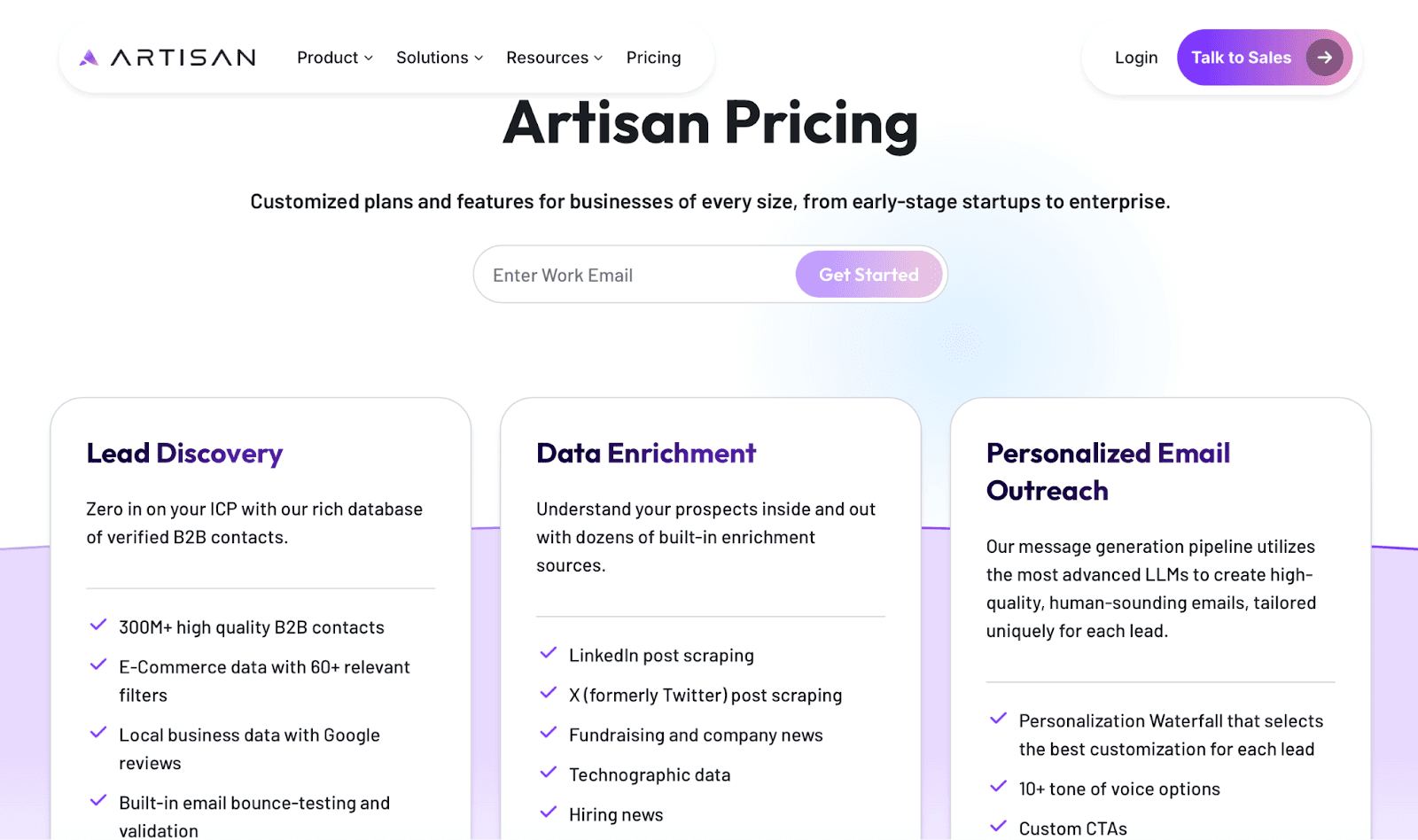
Artisan does not publicly list exact pricing on their website.
Every core feature page ends with “Request Pricing”, and even their FAQ redirects you to sales for a custom quote.
But based on 100+ user reviews and founder reports:
Entry pricing typically starts around $495/mo
Pricing scales based on lead volume, not usage quality
BDR vs. AE “seats” are priced separately
Add-ons (data, LinkedIn automation, enrichment, deliverability) push the real cost higher
Enterprise pricing is completely custom, no published ranges
No transparent tiers, no public feature limits, no published overage costs
Users consistently mentioned the same friction:
You can’t know what you’re paying until you get on a call.
What You Actually Get at the Base Price (~$495/mo)?
Email sending
Basic sequence generation
CRM-style dashboard
Limited lead discovery
Warmup + deliverability features (in theory, not consistently in practice)
Everything else, advanced data, LinkedIn workflows, enrichment, deeper filters, requires a custom plan.
Perceived Value (From Actual Buyers)
Fine as a short-term test
Cost spikes fast once you increase volume
Unclear deliverables = common reason for churn
Price doesn’t correlate to results if reply rates stay low
In short:
Artisan’s pricing looks simple from the outside, but in reality, it’s opaque, volume-based, and unpredictable once you scale.
Coldreach.ai: A Practical Alternative to Artisan AI
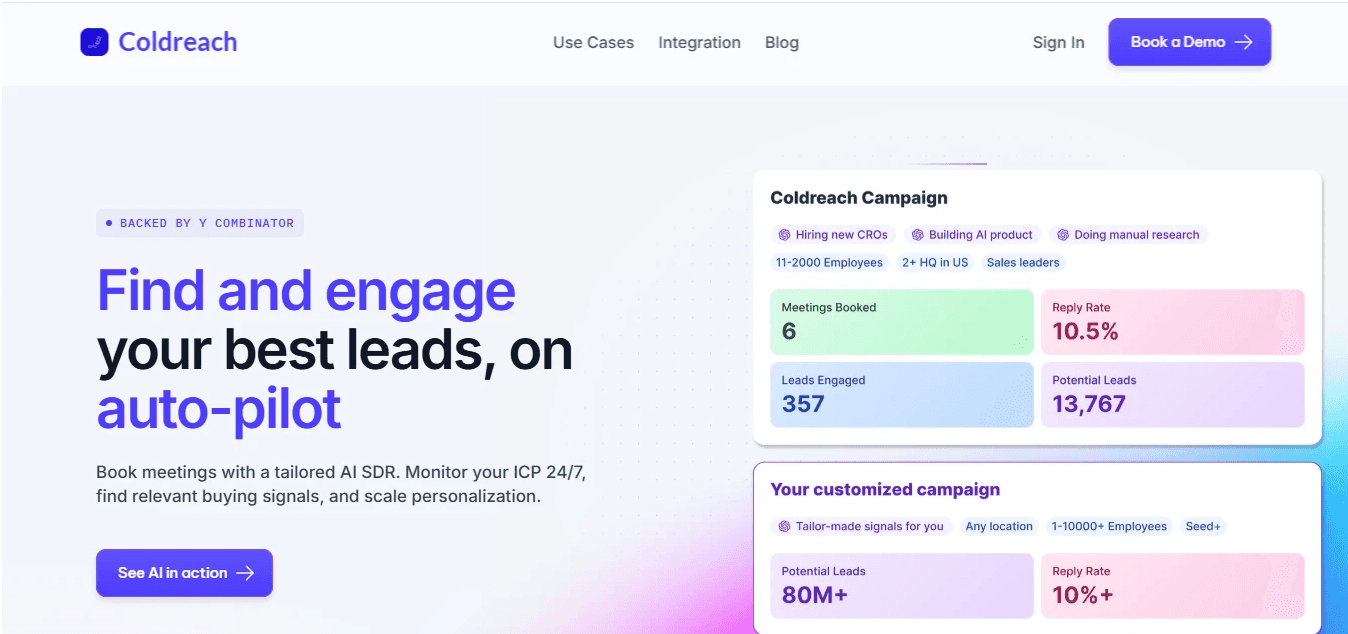
If you’re looking for a clear alternative to Artisan AI, Coldreach.ai is the closest match, but it works very differently.
Instead of sending large batches of cold emails, Coldreach focuses on finding the right leads at the right time, using real buying signals.
Below is a simple and direct comparison.
Why Does Coldreach.ai Work as an Artisan AI Alternative?
1. It finds leads using real buying signals
Coldreach watches 79M+ companies and looks for signals like:
new hires
tech stack changes
funding news
job openings
LinkedIn activity
updates on the company website
When a signal appears, the system sends it to you immediately.
This means you reach out only when the timing is good, not randomly.
2. Email personalization is based on real data
Coldreach uses the signal it finds to write a relevant email.
Example:
If a company hires three new engineers, it uses that detail in the message.
This keeps the email specific, not generic.
3. Campaigns stay targeted
Coldreach builds highly filtered lists using several data sources at once:
LinkedIn, job posts, news, websites, and more.
Lists refresh every week, so you don’t work with stale data.
4. Automation happens only when a signal appears
Coldreach does not blast thousands of emails.
It sends messages only when a strong signal is detected.
This protects your domain and keeps reply rates healthier.
5. Works with your current tools
Coldreach integrates with:
Salesforce
HubSpot
Salesloft
Outreach
Apollo
Slack
Gong
LinkedIn
API
No need to change your sales stack.
6. Pricing is simple and modular
Coldreach does not use flat pricing.
You pay based on:
which signals you want
how many agent workflows you run
how much volume you actually need
You only pay for what you use.
Artisan AI vs Coldreach.ai (SEO-Friendly Comparison Table)
Feature | Artisan AI | Coldreach.ai |
Lead Discovery | Large database | Signal-based, real-time |
Personalization | Generic LLM emails | Based on actual buying signals |
Automation | High-volume sending | Sends only when intent appears |
Deliverability Control | Limited | Full domain + warmup control |
Agent Model | One AI SDR (“Ava”) | Multi-agent workflows |
Pricing | Not public, starts ~$495/mo | Modular, usage-based |
Best For | Quick outbound tests | Focused outreach and timing |
Artisan AI vs Coldreach: Which One Should You Choose?
Choosing between Artisan AI and Coldreach depends on what you actually need.
Both tools help with outbound sales, but they work in very different ways.
Here is the clearest way to decide.
Choose Artisan AI if…
You want to start sending emails fast
You want a tool that feels like a simple “AI SDR”
You don’t need deep personalization
You don’t need advanced targeting
You just want basic cold email automation
Your ICP is broad and not very niche
Artisan is best for quick tests, small teams, and early-stage outbound.
Choose Coldreach.ai if…
You care about sending emails at the right time
You want leads based on real buying signals
You need stronger personalization
You target specific ICPs
You want control over deliverability
You prefer quality over volume
You want data from LinkedIn, job posts, websites, and news, all in one place
Coldreach is built for teams who want relevant outbound, not high-volume outbound.
Conclusion
At the end of the day, choosing an outbound tool comes down to what you actually need, not what the homepage promises.
After reviewing 100+ Artisan AI reviews, talking to users, and testing the product yourself, the pattern is clear:
Artisan AI is easy to start, but results drop once you scale.
Emails often feel generic, lead quality is inconsistent, and deliverability control is limited.
Pricing isn’t transparent, and many users churn after 30–60 days.
Coldreach takes the opposite route:
It finds leads based on real buying signals.
It personalizes emails using real context, not templates.
It protects your domain and only sends when intent is strong.
And pricing is modular, so you only pay for what you use.
If you want fast outbound activity, Artisan can work for a short test.
If you want consistent, high-quality meetings from accounts that actually care, Coldreach is the stronger choice.
Frequently Asked Questions
Is Artisan AI worth the price in 2026?
Artisan AI does not publish pricing publicly. Given that Ava lacks deep signal-based targeting and gives limited control over outreach logic, many teams find the cost hard to justify versus alternatives.
What are the best Artisan AI alternatives?
The top Artisan AI alternatives are Coldreach, which is strongest for signal-based outreach starting at $899/month, Salesforge Agent Frank for deliverability control, and 11x.ai for enterprise teams with larger budgets. Each offers a different balance of automation depth, pricing, and control.
Can AI SDRs replace human SDRs?
AI SDRs handle the repetitive top-of-funnel work: account research, email writing, sending, and follow-ups. They do not replace the human judgment required for discovery calls, negotiation, or complex relationship building. Most teams use AI SDRs to fill their calendar so human reps can focus on closing.
If you’re ready to see how Coldreach fits your ICP and workflow, you can book a quick demo and see it live.